Top Nerve Recovery Researcher: I Found The Reason Why Your Feet Keep Burning Long After Your Last Drink… And Nothing Helps
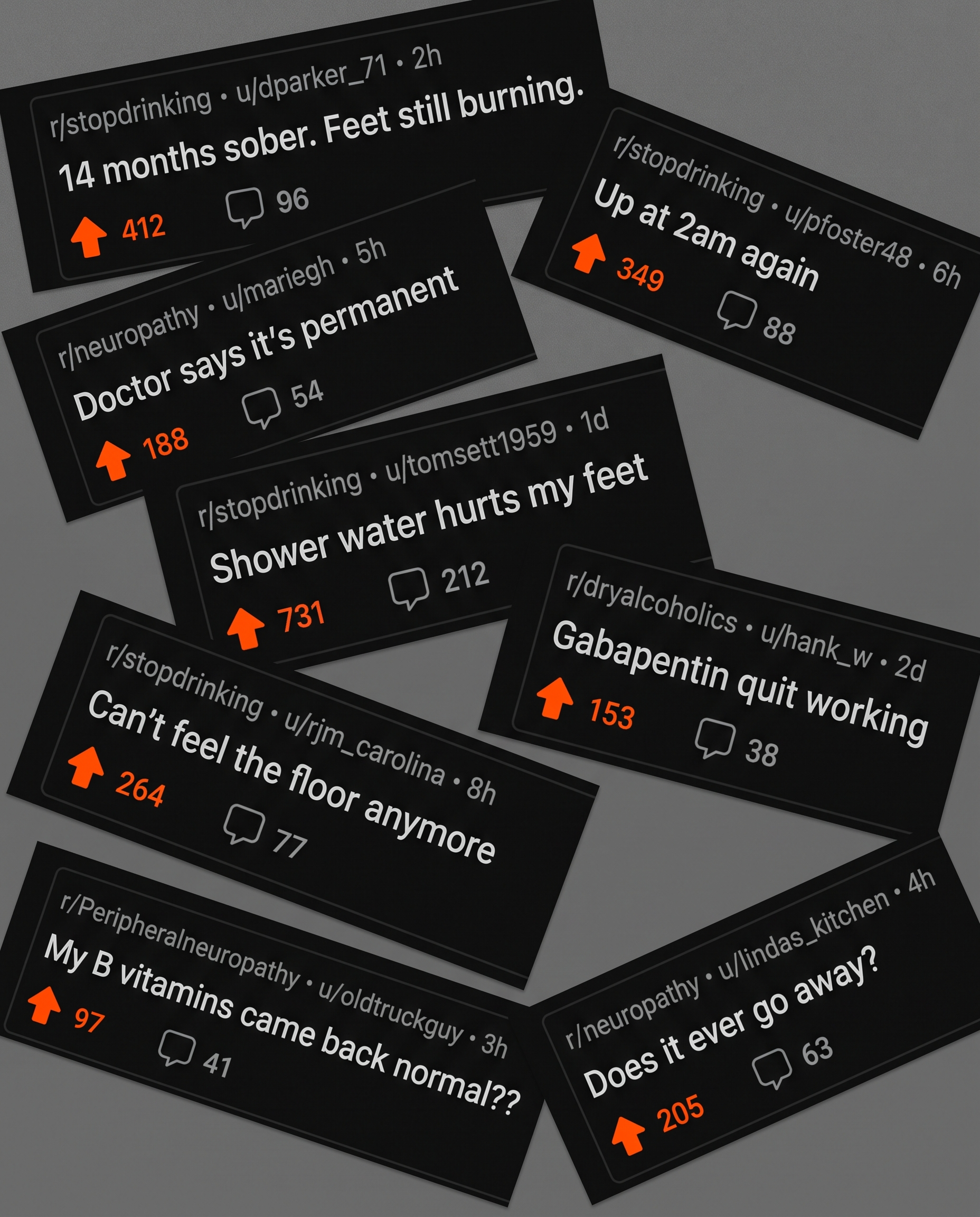
We all kept failing for the same reason. I studied 27,318 people who quit drinking and kept burning — and their own lab results explained what every doctor missed.
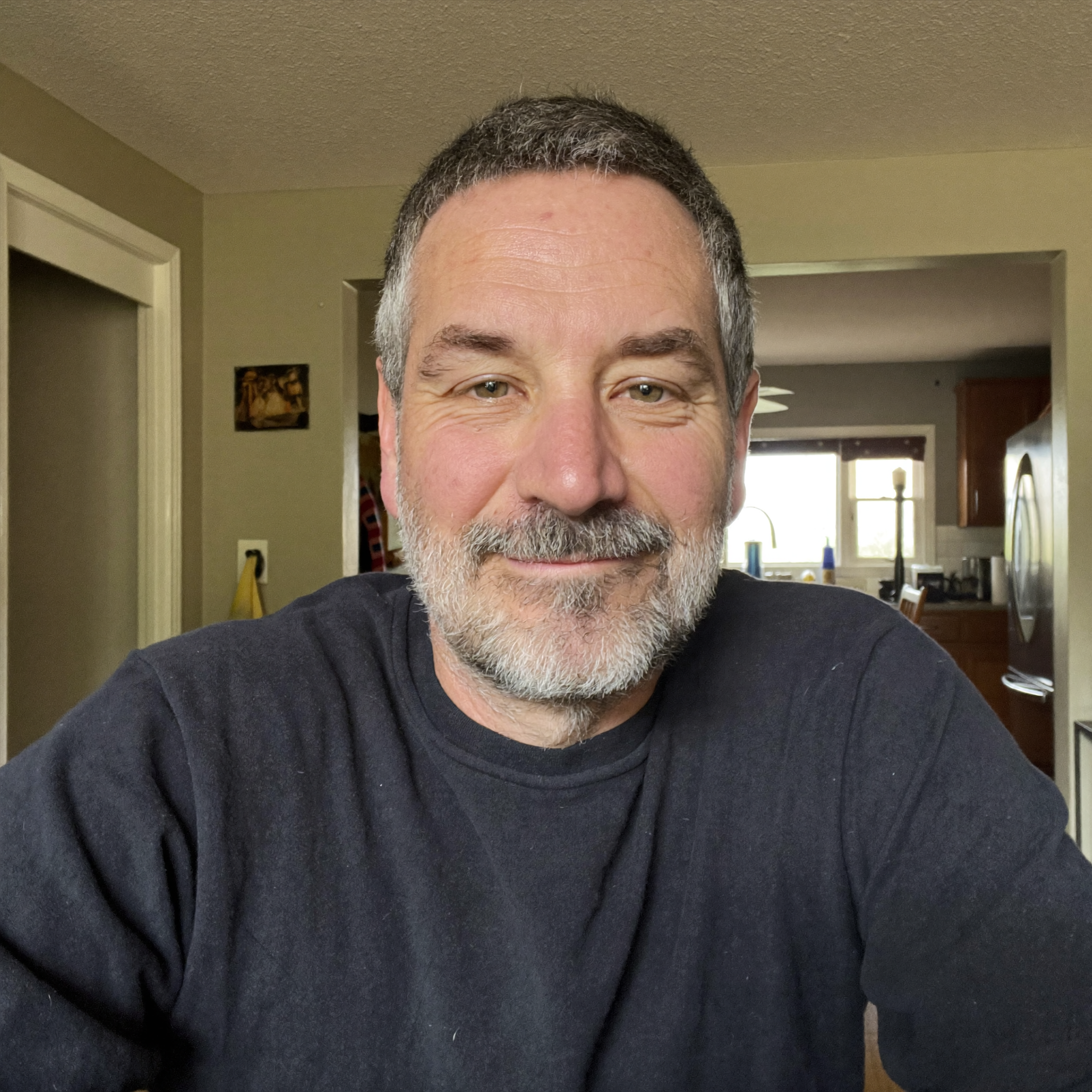
I drank most of a fifth of whiskey a night for nineteen years. I am not going to dress that up and I am not going to apologise for it on this page either. I stopped seven years ago, at forty-nine, and it was the hardest thing I have ever done.
I expected my body to thank me. Most of it did. My liver numbers came back. My sleep came back. People at work said I looked ten years younger.
My feet did not get the memo.
Fourteen months sober, they were worse than the day I quit. Burning from the arches forward every night around two. Shower water felt like it was stinging them. I slept with a box fan pointed at the end of the bed and my feet on top of the covers.
The neurologist was kind about it. He said the damage was done, that the nerves would not repair, and that stopping had kept it from getting worse. He wrote me a prescription for gabapentin and told me to keep taking my B-complex.
I asked him if there was anything that went after the damage itself. He said no. Nothing approved.
So I did what everyone in recovery learns to do. I decided this was the bill. Nineteen years, and this was what I owed.
Nothing works.
That is what I typed into a search bar one night at two in the morning, feet on fire, expecting nothing.
I found 27,318 people living the exact same nights.
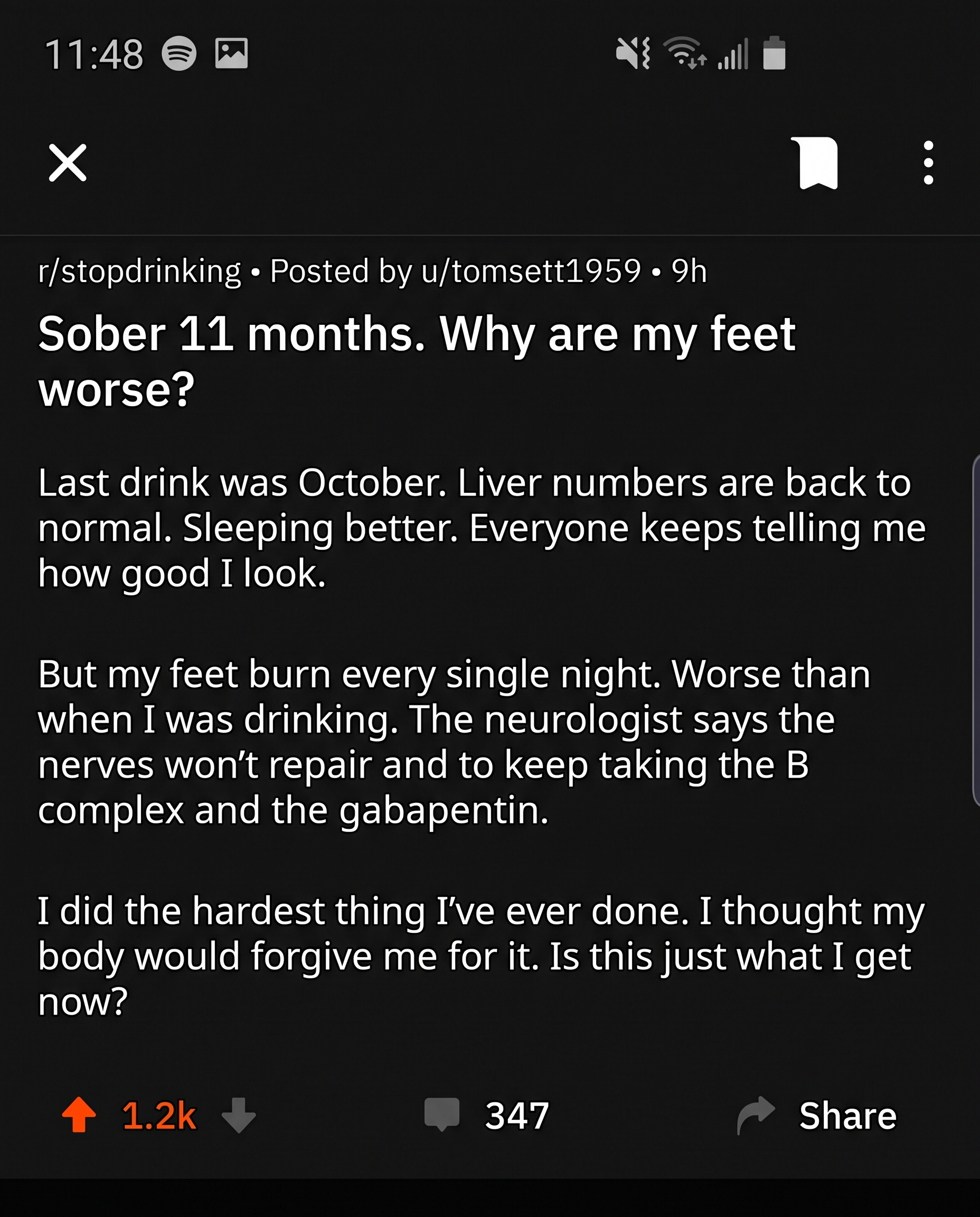
I read that post four times. I thought my body would forgive me for it. I had never said that sentence out loud, and a stranger had written it for me.
I opened the comments expecting the usual. Give it time. Try benfotiamine. Ask about a higher dose.
Instead I saw thousands of people using my exact words:
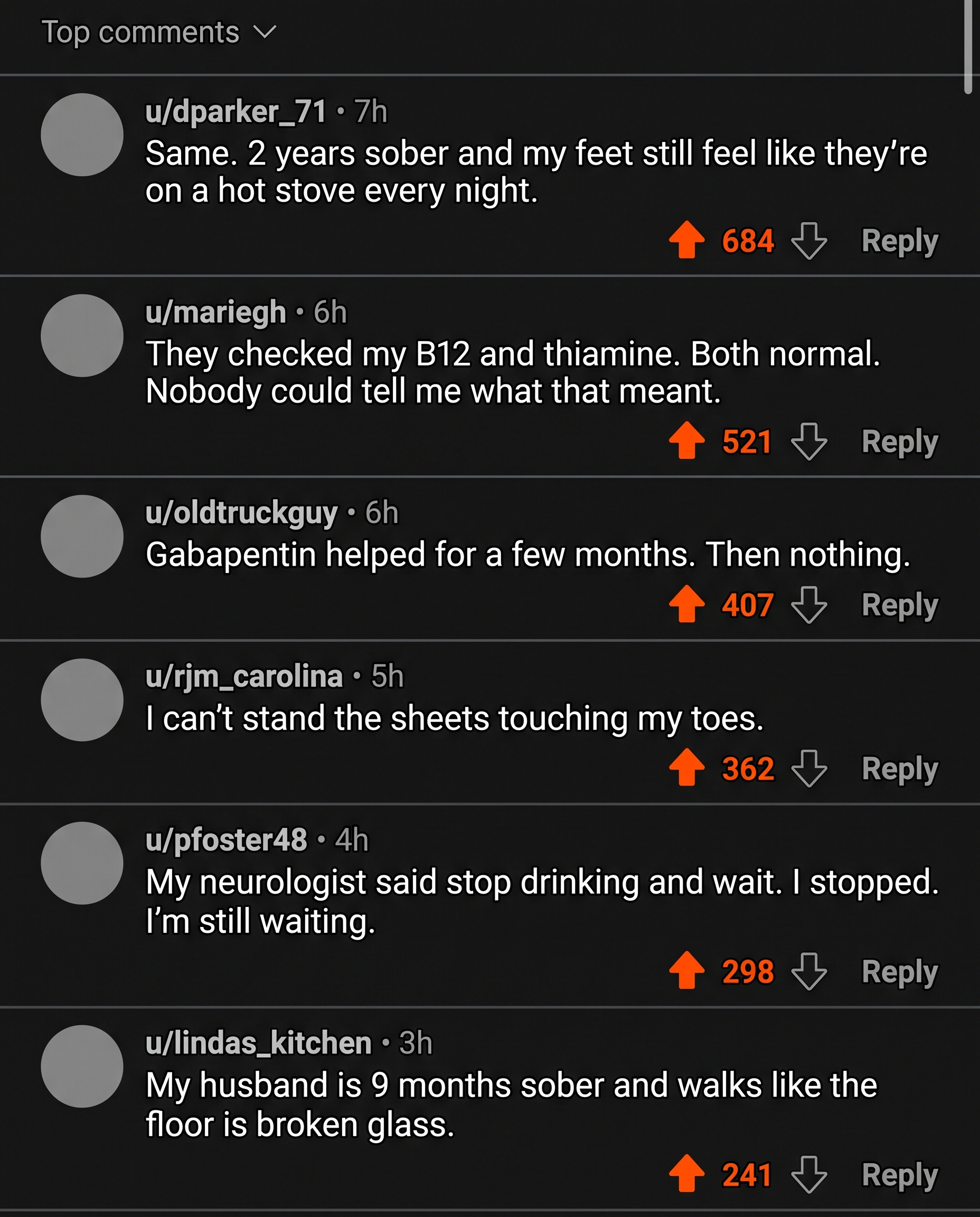
Different ages. Different drinks. Some two weeks sober and some nine years. Men and a lot more women than I expected. But every one of them described it with the same words.
Not similar words. The exact same ones.
Sober. Doing everything right. Still burning. And every one of them had been told, in one form or another, that this was simply the price.
Then, about three hundred comments down, somebody wrote something that stopped me cold.
Then I Saw Something That Made No Sense
No pitch. No link. Five flat lines from someone who had obviously typed them before.
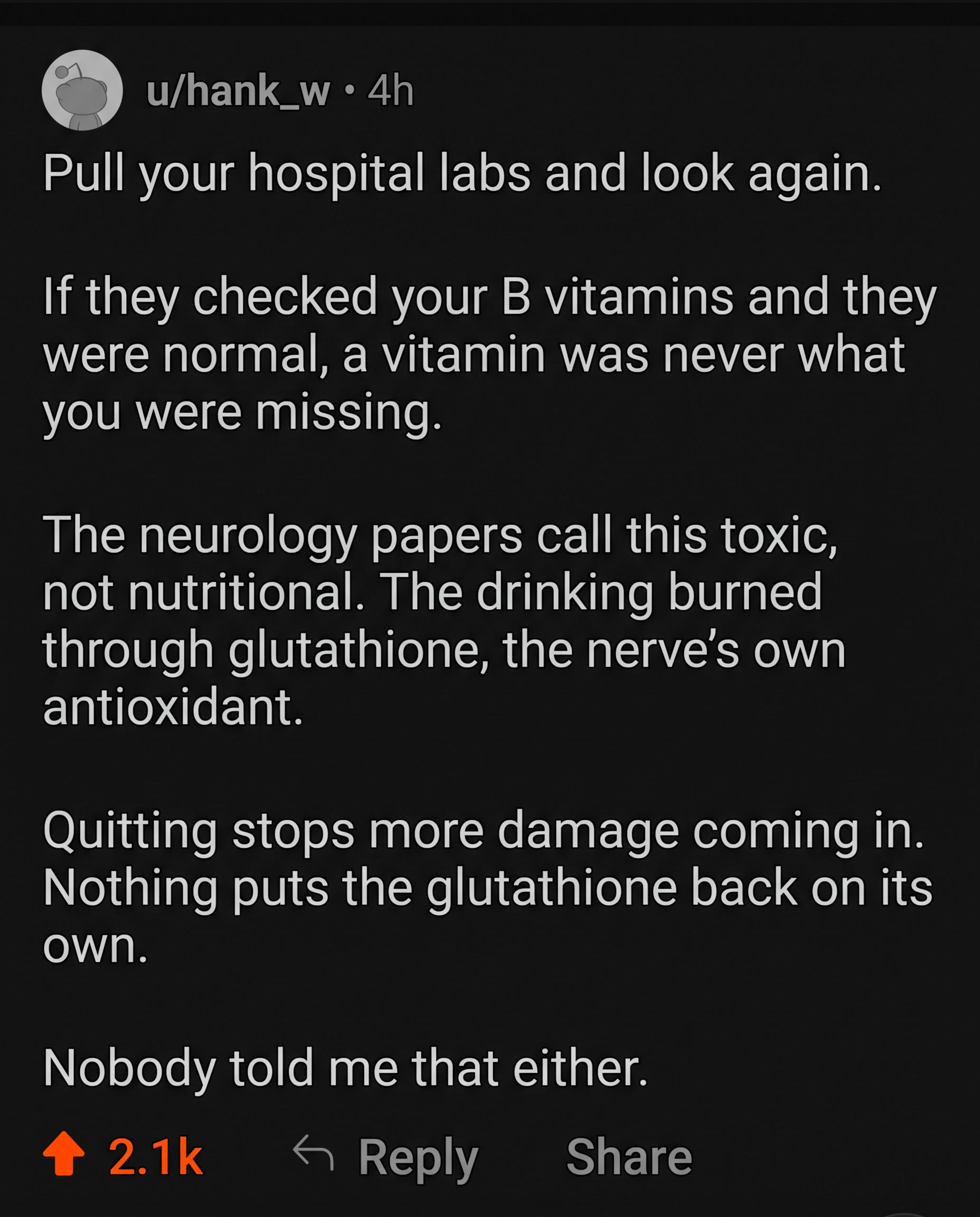
I got up and found my own discharge papers in the kitchen drawer.
I had been admitted twice in my last year of drinking. Both times the doctors said the same thing to my face: they expected to find a B-vitamin deficiency, and they didn’t. My levels were normal. I remember being mildly surprised and then forgetting about it completely.
But if my vitamin levels were fine, then a vitamin was never what I was missing. So what had nineteen years actually done to the wiring in my feet?
At 3 a.m., I found the research. And it changed everything.
It Wasn’t Your Fault. It Was Biology.
The neurology literature stopped treating this as a vitamin problem years ago. The phrase in the papers is blunt: alcohol-related nerve damage should be regarded as toxic rather than nutritional. Not a shortage. A poisoning.
That matters more than it sounds. A shortage is a verdict on how you lived. A poisoning is a chemical event — a specific molecule doing a specific, documented thing to a specific tissue. And chemical events have chemical answers.
I ended up calling what I found The Stripped Shield.
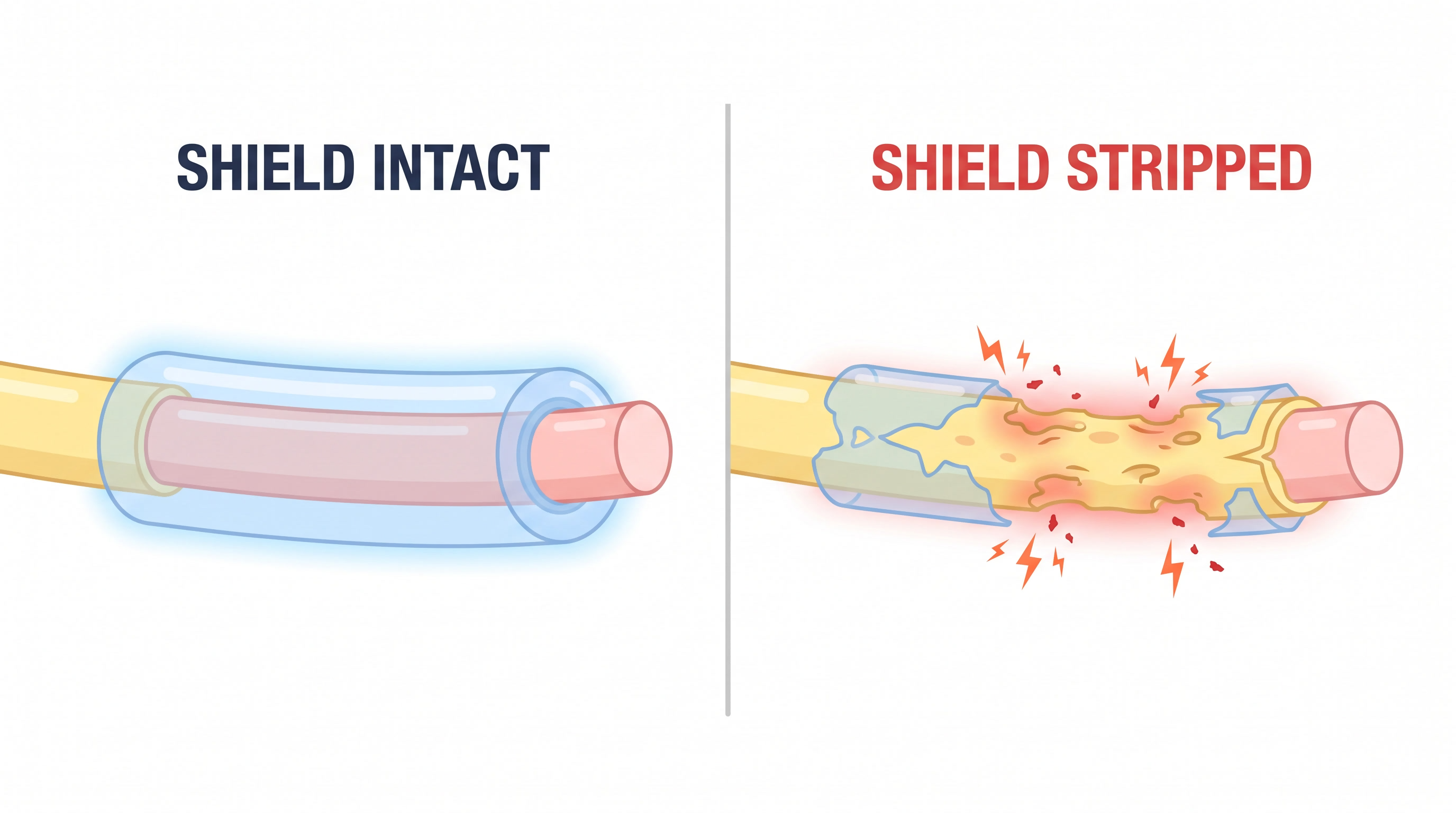
The Three Things The Stripped Shield Was Doing — Simultaneously
1. The Shield Gets Stripped
Your body turns every drink into acetaldehyde — not a hangover chemical, a direct nerve toxin. Neutralising it burns through glutathione, the nerve’s own built-in antioxidant shield. Night after night, year after year, the shield runs down faster than the body can restock it.
2. The Burn Outlives The Bottle
With the shield gone, oxidation keeps chewing on the fibre — its proteins, its fatty outer sheath, the wire itself. The longest nerves in your body go first, which is why it is always the feet before the hands. Quitting stops fresh acetaldehyde arriving. It does not rebuild the shield. That is how your feet can burn louder after you quit.
3. Every Standard Answer Is Aimed At A Different Problem
The B-complex answers a vitamin shortage — the one your own labs said you didn’t have. Gabapentin turns down the pain signal at the far end of the wire. Not one thing in the standard plan goes anywhere near the oxidation that is still running. That is not incompetence. It is simply not what they were built to do.
So the burning is not a scar. A scar is finished. A scar doesn’t creep from your little toe to your arch to your ankle, and it doesn’t wake you at two in the morning. What you are feeling is something still happening — which is frightening for about ten seconds, and then it is the first good news anyone has given you, because something still happening is something you can still act on.
What Didn’t Work — And Why
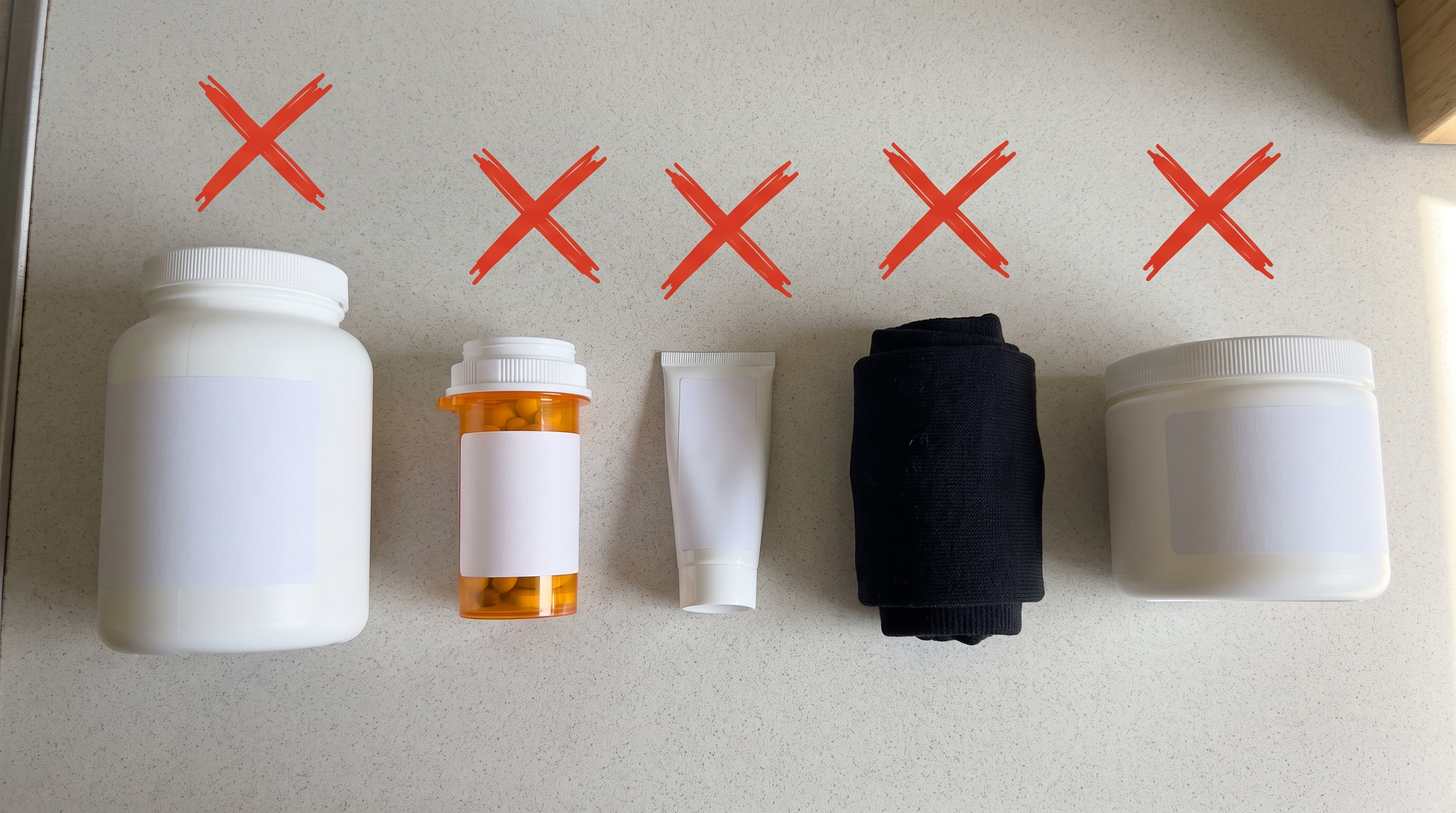
The B-complex, and then more B-complex. Fourteen months of it. When it did nothing I doubled it — which is exactly how people end up with too much B6, and too much B6 causes its own nerve damage. I was stacking a second problem on the first one, trying to fix a shortage I never had.
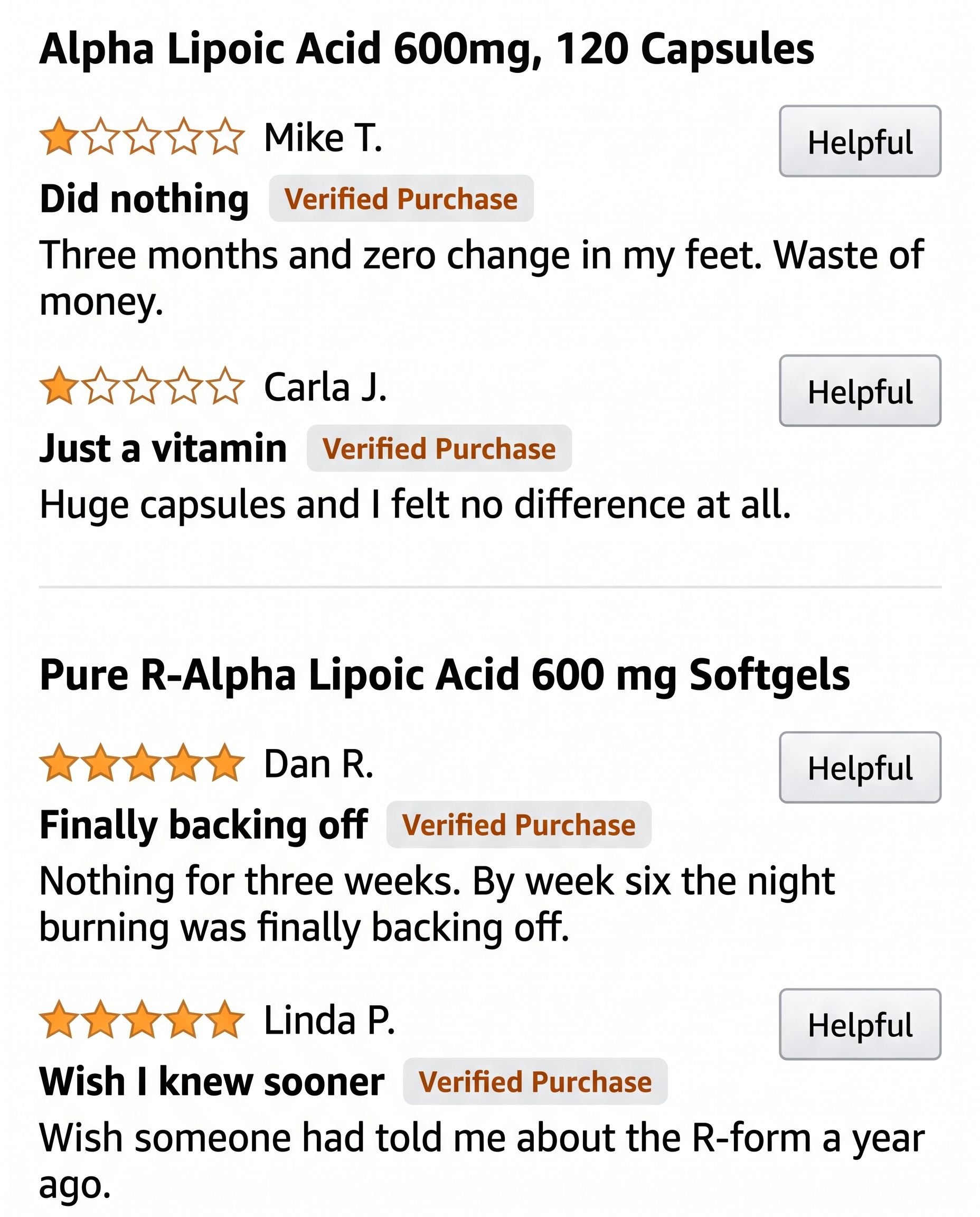
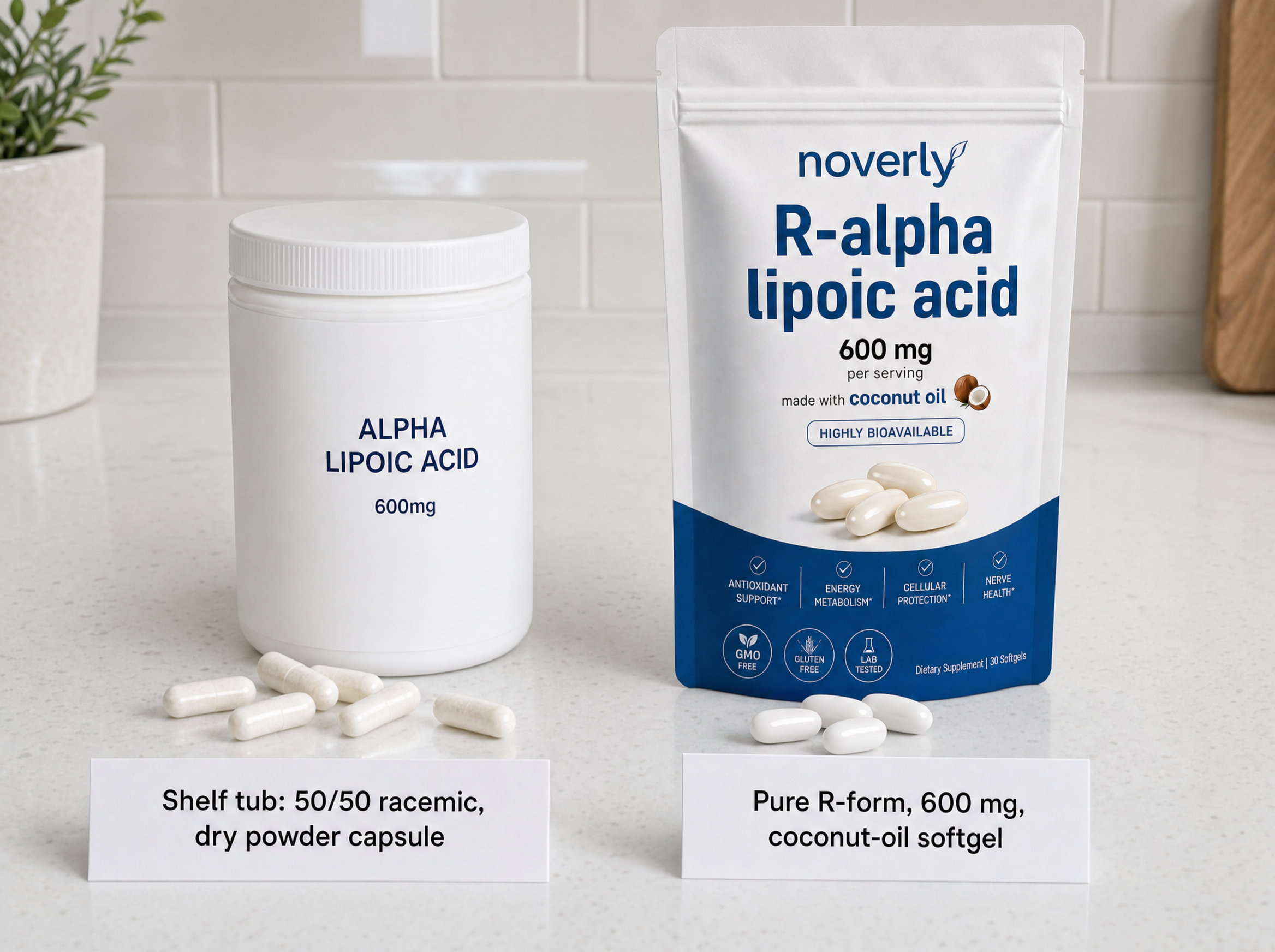
The cheap alpha lipoic acid off the shelf. This one nearly made me give up on the right idea. It was the first antioxidant I tried, fifteen dollars a tub, and after three months I wrote it off. Then I read the back: racemic — half the active form your body uses, half a synthetic mirror-image left over from manufacturing. The label said 600 mg. The part my body could actually use was nowhere near that.
The creams, the socks and the frozen water bottles. All genuinely useful at 2 a.m. None of them reach inside a nerve.
I Tried To Buy Exactly What I Needed. It Didn’t Exist.
So I went looking for the real thing.
Pure R-form. The full 600 milligrams. One softgel, not six.
Every bottle I picked up was racemic, or half-dosed, or buried in an eighteen-ingredient “nerve complex” with B6 in it.
Eleven brands. Hundreds of dollars. Months.
Not one of them was the thing the research described.
That’s when I found what actually works.
Here is why alpha lipoic acid kept showing up in everything I read. It is one of the only antioxidants that works in both water and fat, so it reaches the watery inside of a nerve cell and its fatty outer sheath. And it helps the body recycle glutathione — the exact shield the drinking stripped — along with vitamins C and E. In animal research on injured nerves it cut axon damage and brought glutathione back up.
The human evidence at 600 mg a day comes from diabetic nerve damage, not from drinkers, and I want to be straight with you about that: nobody has run that trial on people like us. But it is the same injury to the same fibres by the same route — oxidation — and that shared mechanism is exactly why so many people in that thread said their own neurologist had already told them to take it.
The version that matters is the isolated R-form — the active half, on its own, at the studied dose, in a lipid the body actually takes up. It is unstable and expensive to make, so almost nobody bothers. I tracked down a small formulation lab that specialised in it and asked if I could watch them work.
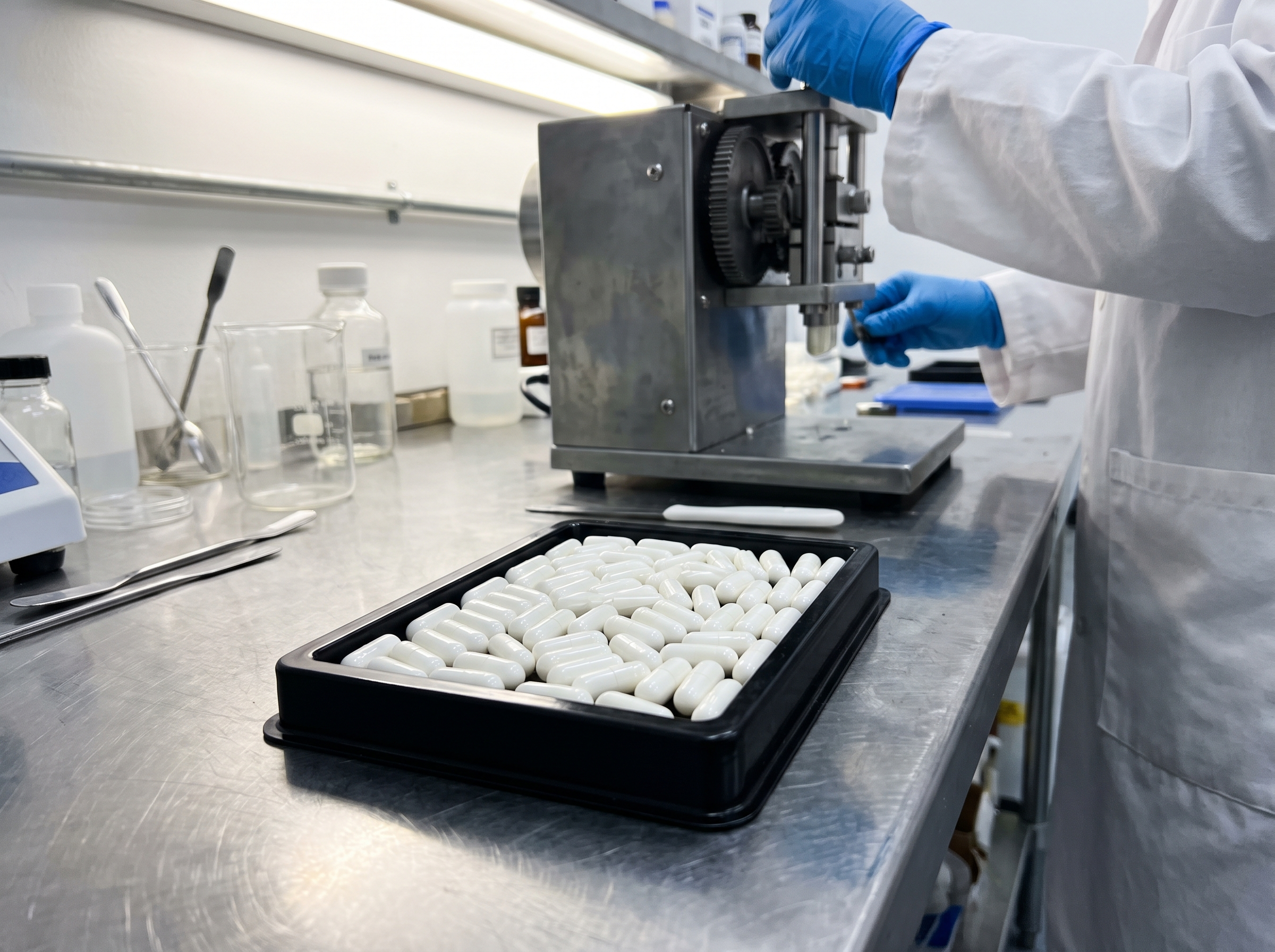
It took months. Batches that separated. Batches that oxidised. Batches that tested under label claim and went in the bin.
But it worked.
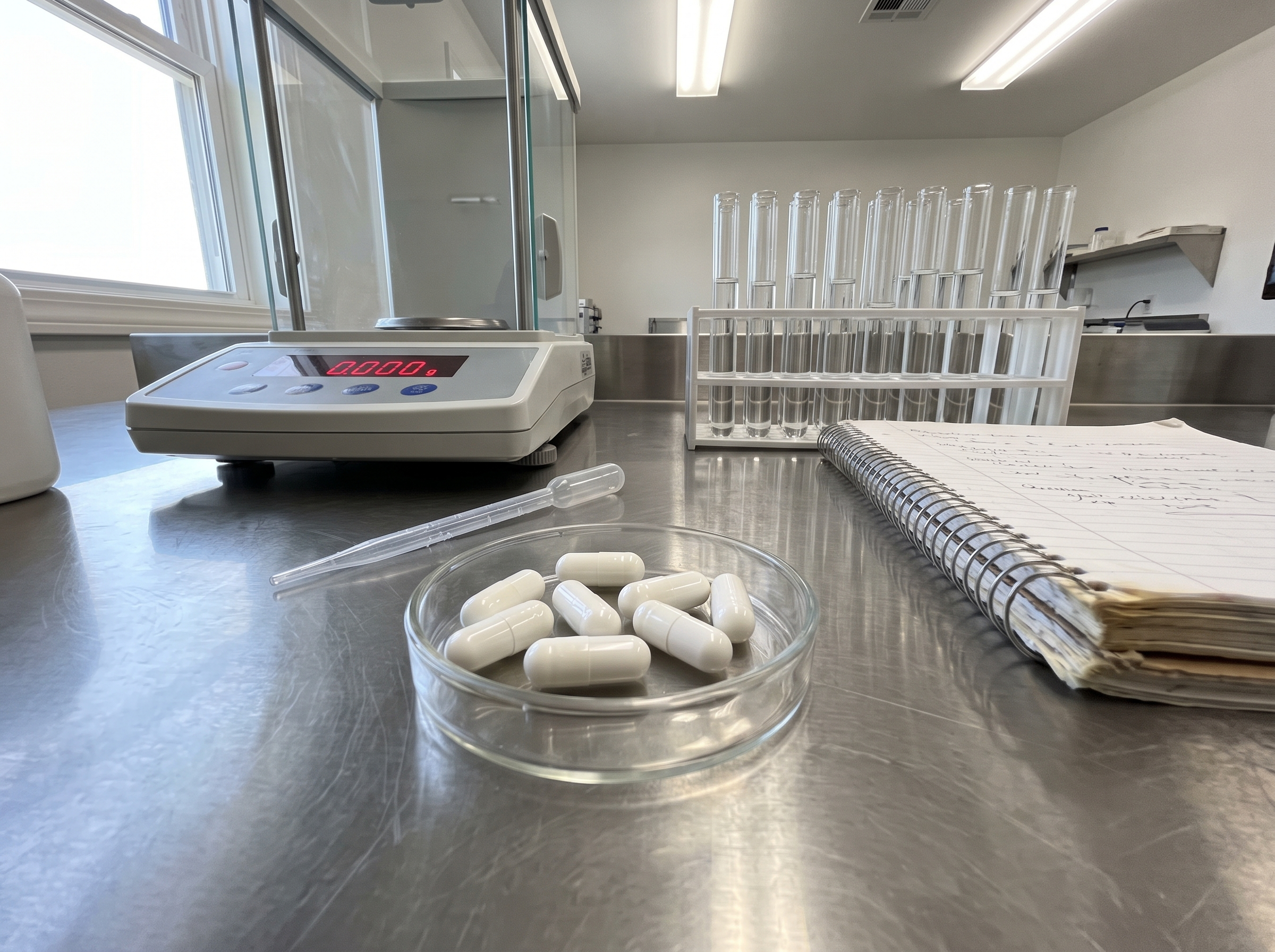
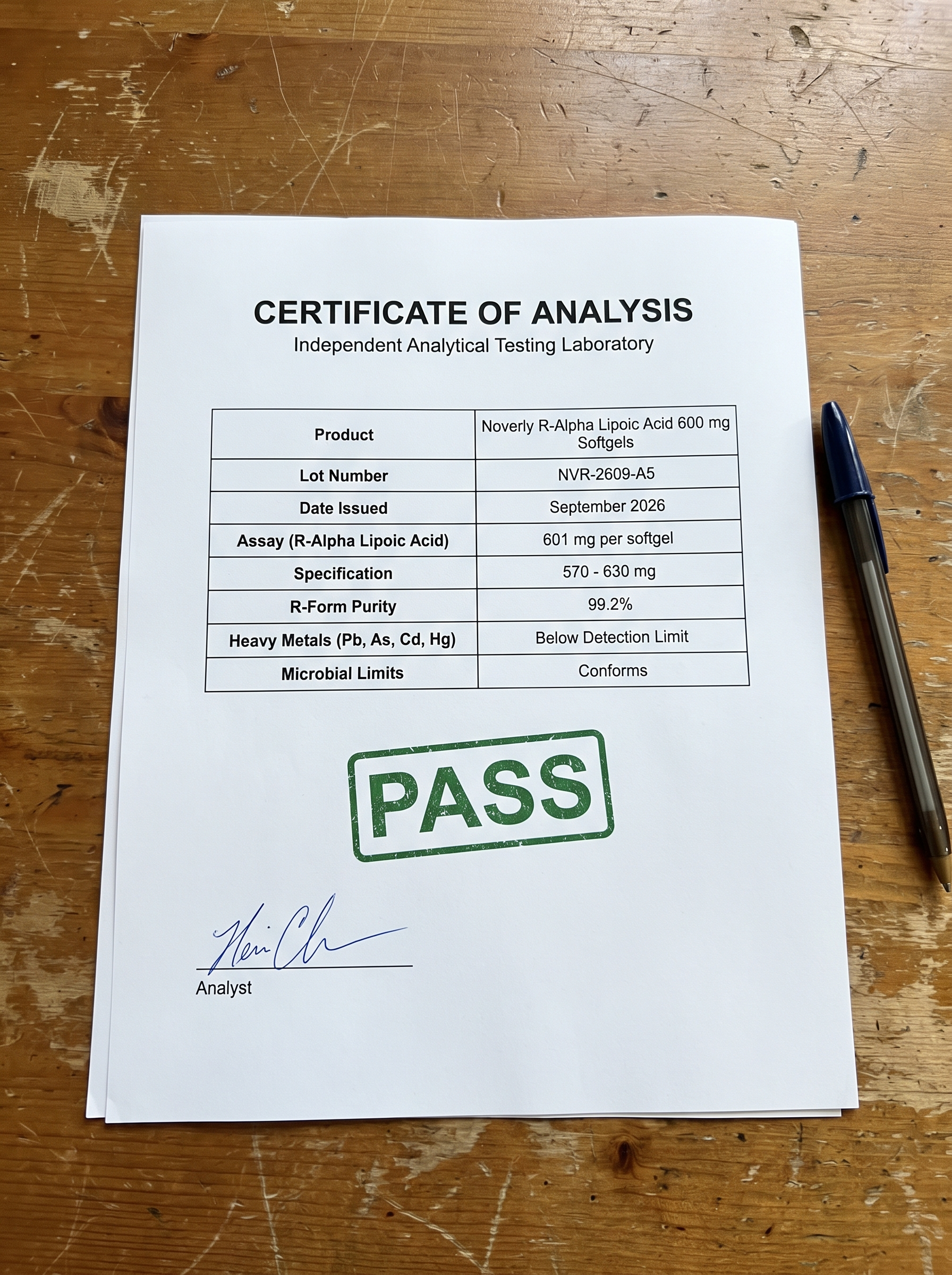
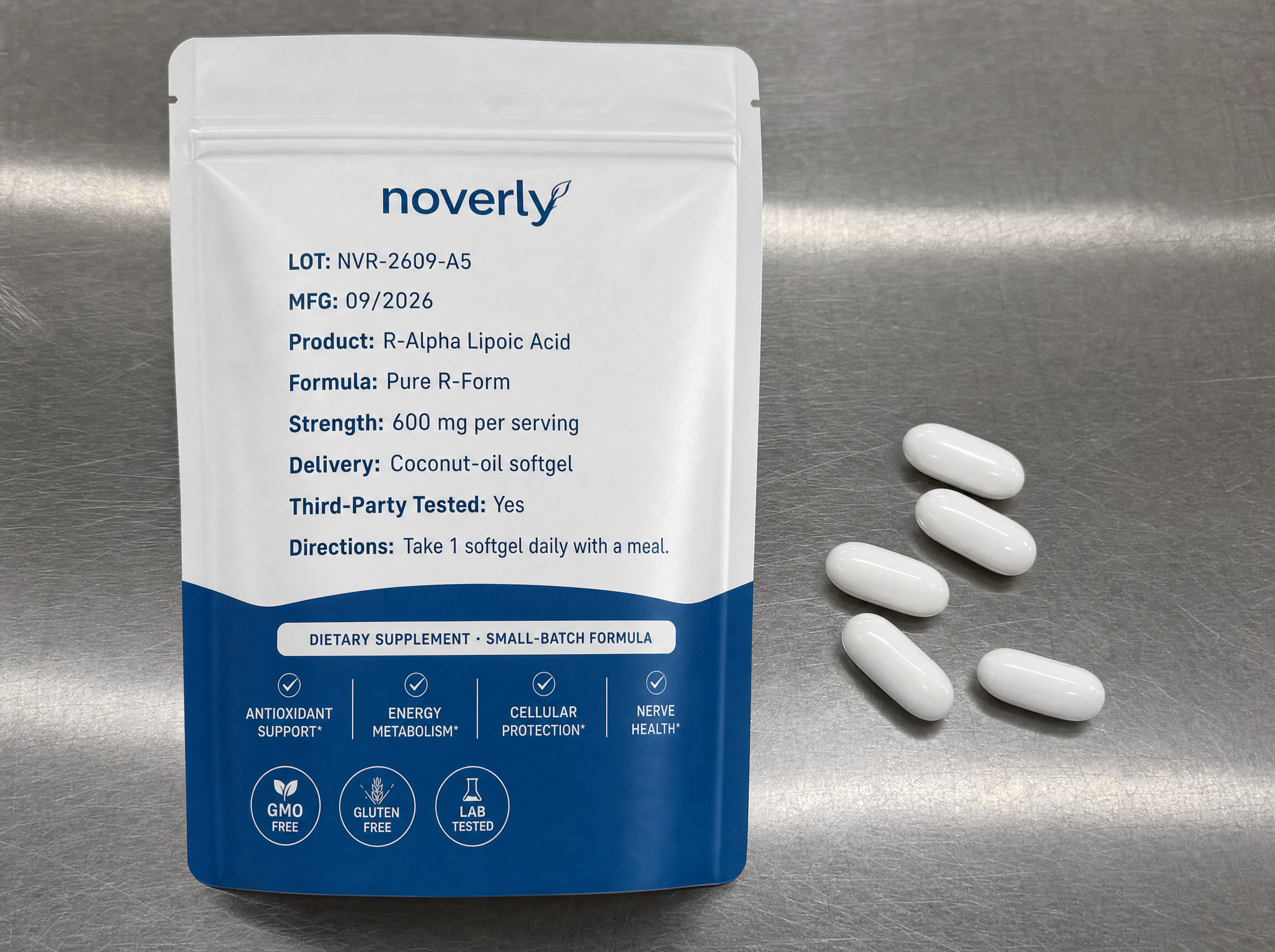
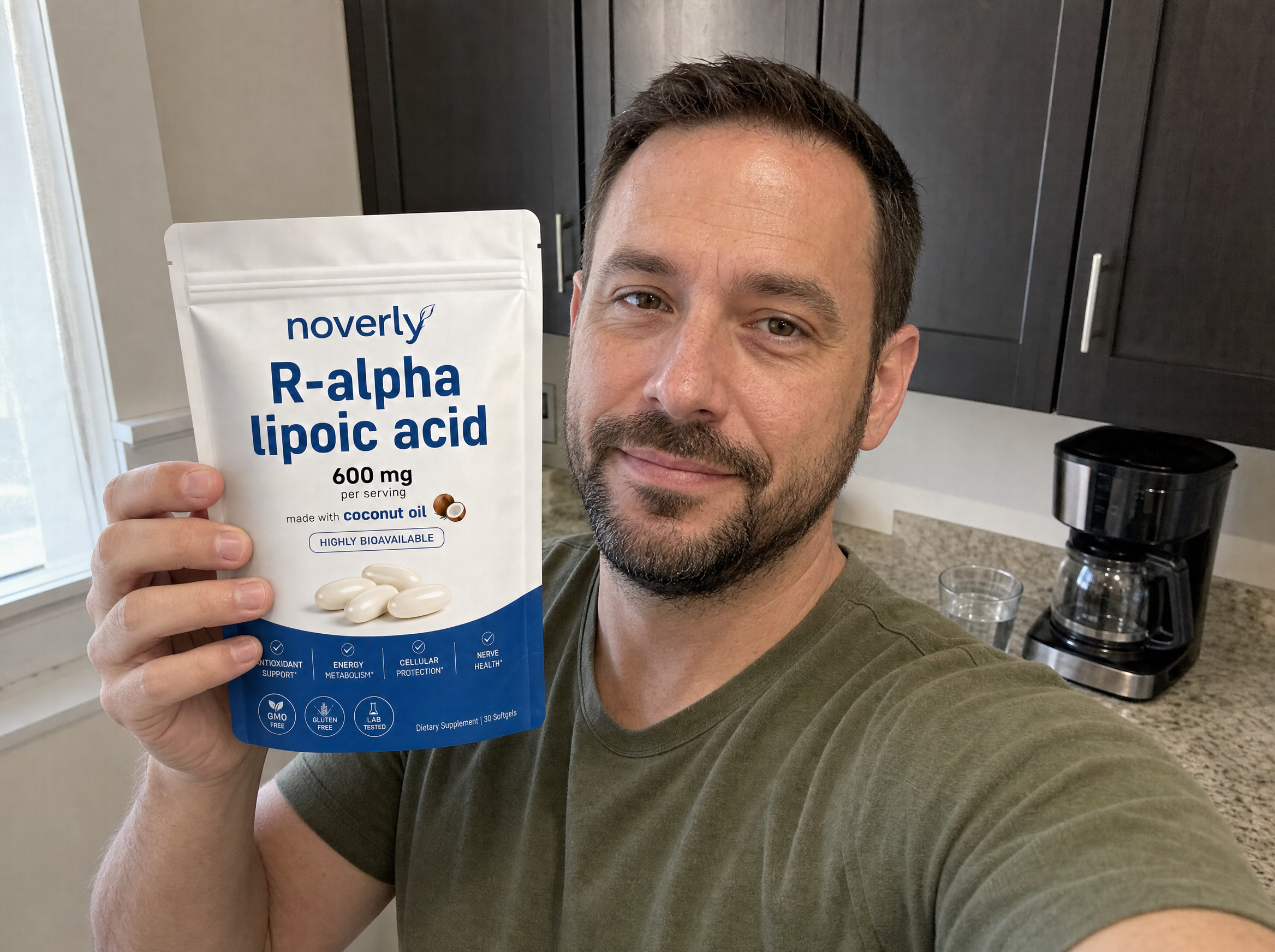
Pure R-form. 600 mg per serving. Suspended in coconut oil inside a softgel instead of pressed dry into a capsule. And every single batch sent to an outside lab that has no stake in the answer.
The Night I Finally Tried It. Changed Everything.
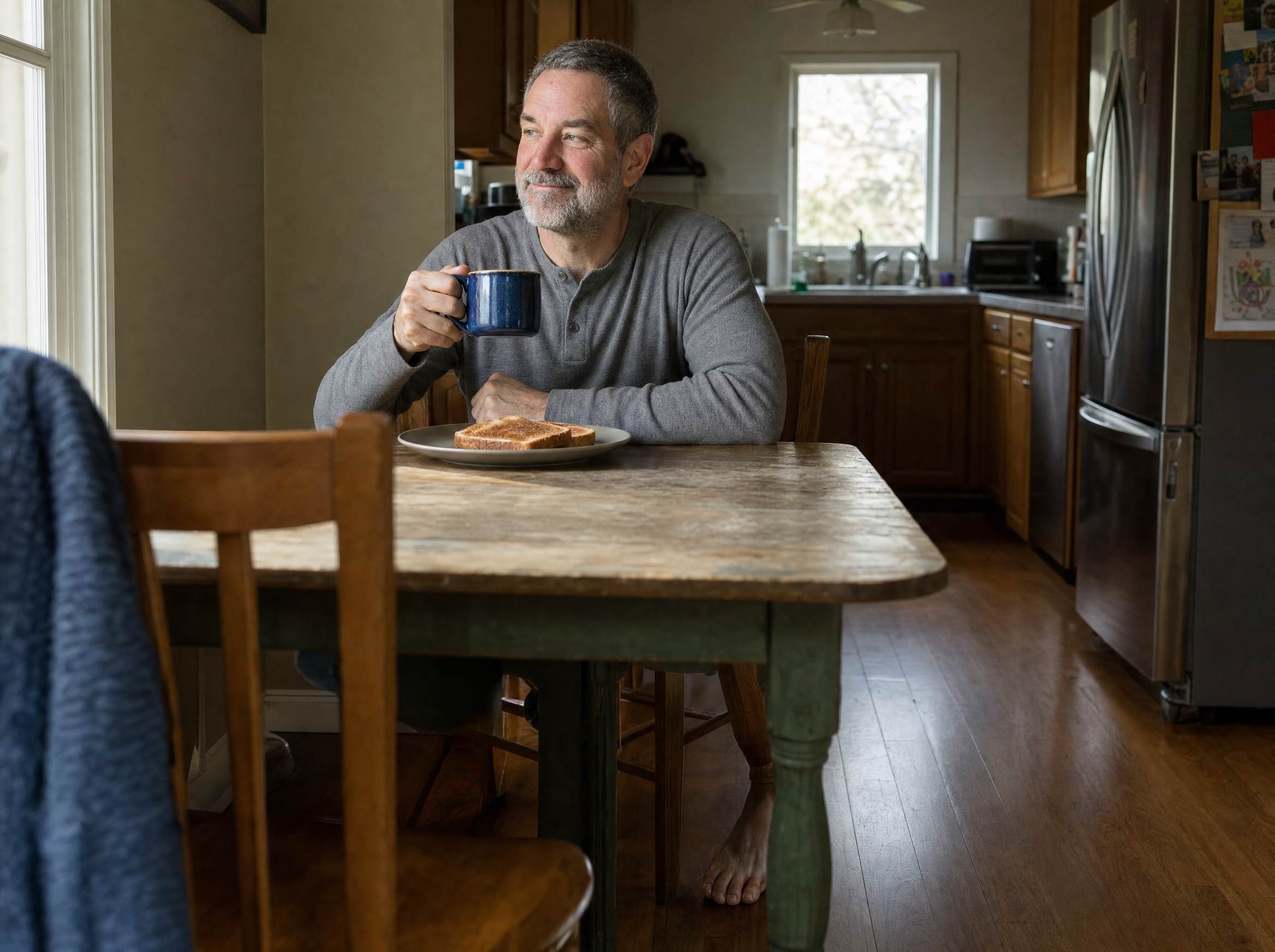
One softgel with breakfast. That is the whole protocol. No stack, no loading phase, no handful of pills lined up on the counter.
Nothing. I want to be honest about that, because I nearly quit on it. The shield took nineteen years to strip. It was never going to come back in a week.
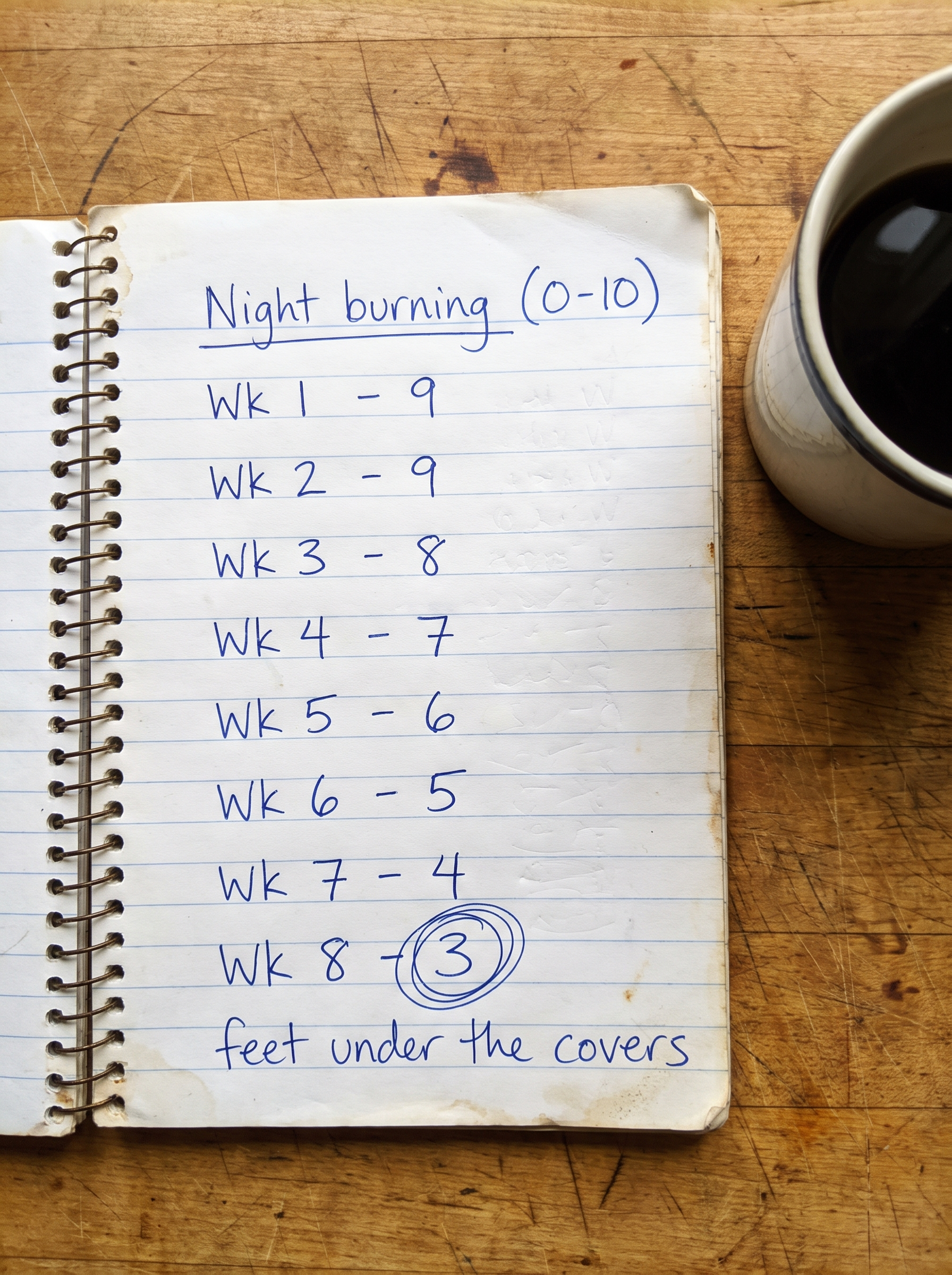
Maybe the 2 a.m. flare was arriving a little later. Maybe. I had been fooled by my own hope before, so I started scoring it in a notebook instead of trusting my memory.
I stood in the shower and didn’t brace. It took me a second to notice I hadn’t. Then I turned the fan off at night, and a week later I slept with my feet under the covers.
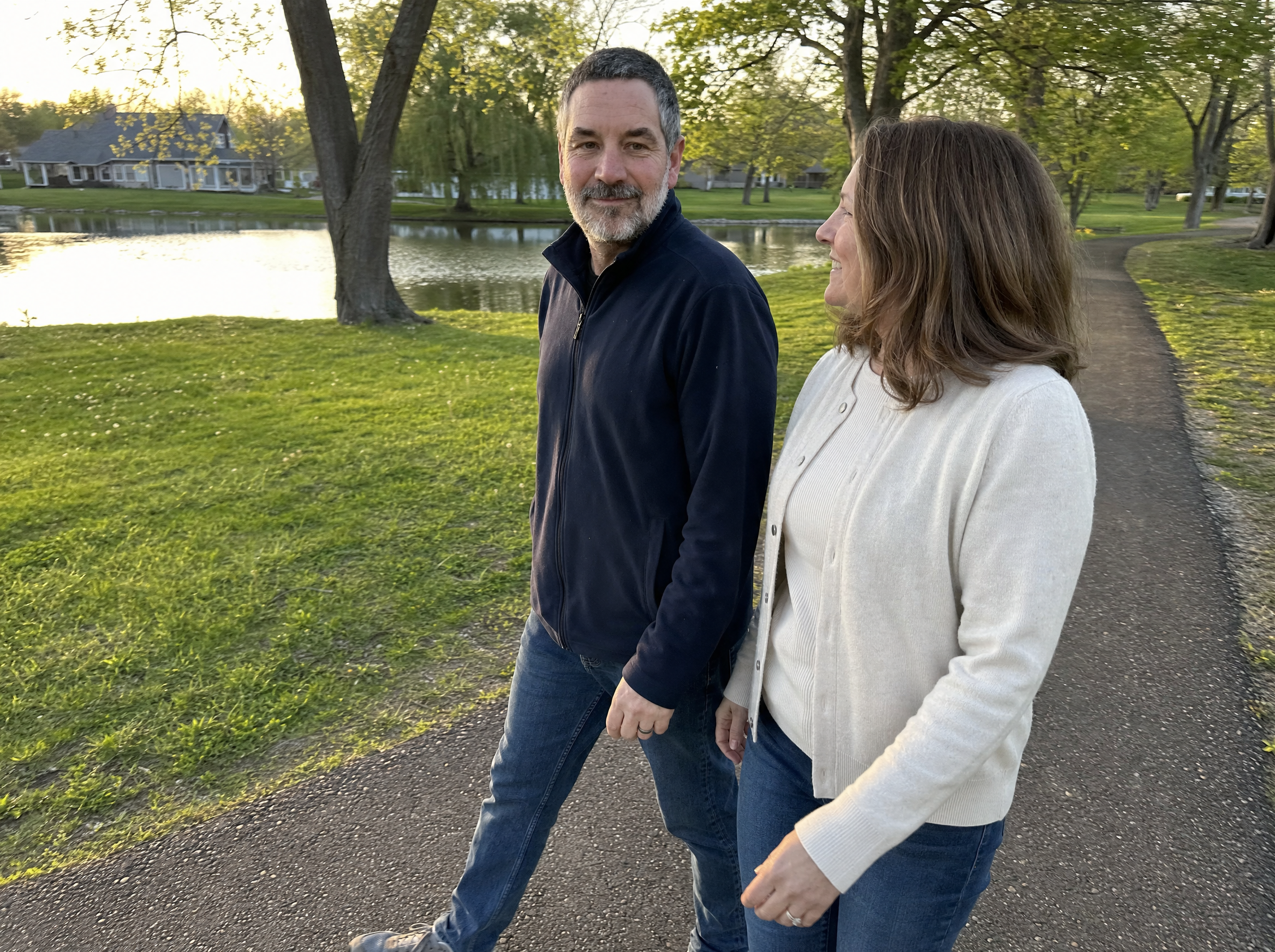
I walked the whole loop around the park by my house, which I had not done since before I quit. My wife walked it with me and neither of us said anything about it until we got home.
Every night I had scored the burning out of ten. Over eight weeks it went from a 9 to a 3. The numb patch on the ball of my left foot is still there. The fire mostly isn’t.
Get Your Nights Back. Sober And Rested.
I did not want to be one more guy on the internet with a story. So I went back to the thread that found me and asked people to test it themselves and post their number either way.
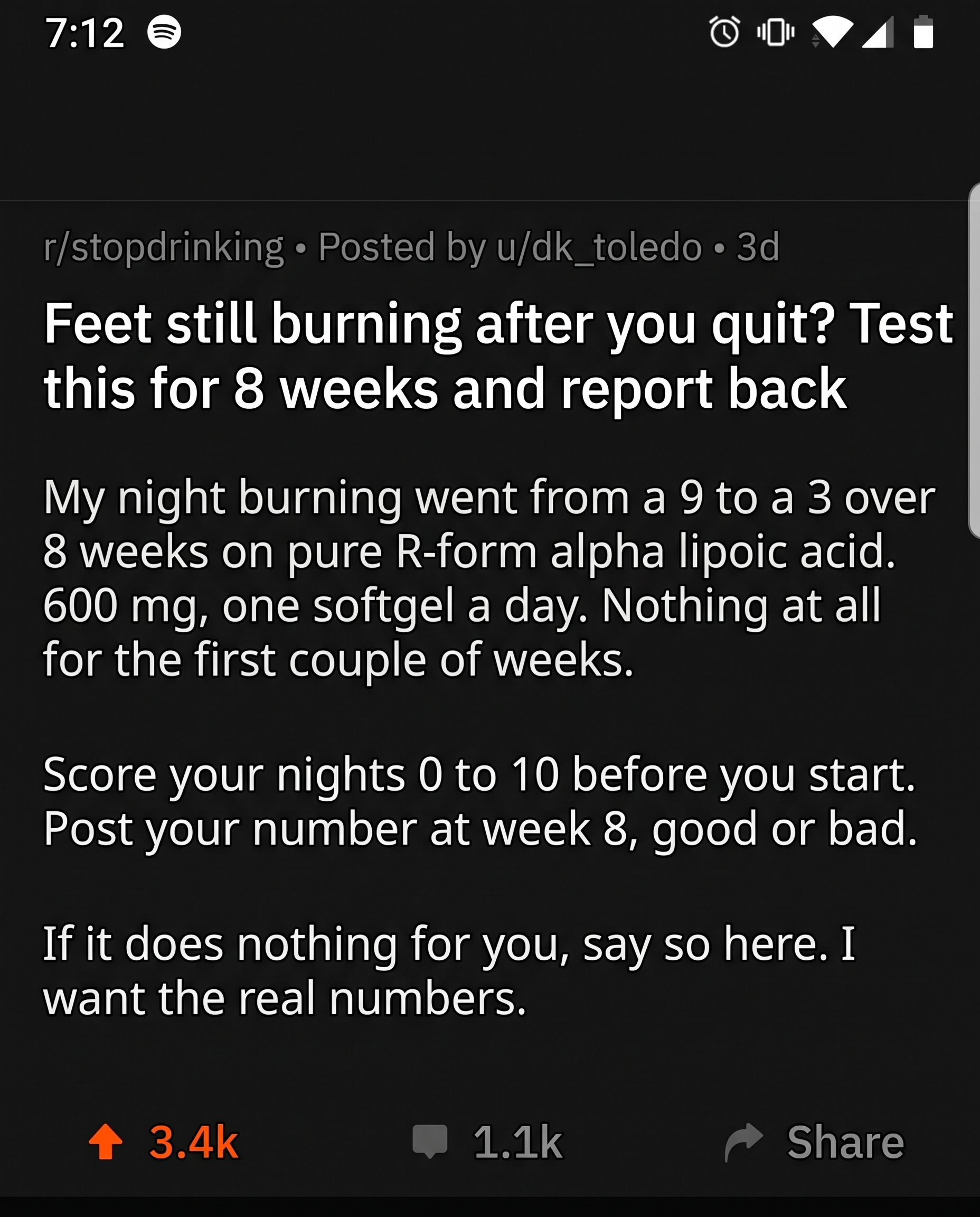
Forty people took me up on it. Not one of them came back to tell me I was wrong.
Then it was four hundred. Then it was thousands. Same story in different handwriting: nothing for the first few weeks, then the nights go quiet first, and the thing they had been told was the price of their past turns out to have had a chemical cause the whole time.
Don’t Take My Word For It — Take Theirs
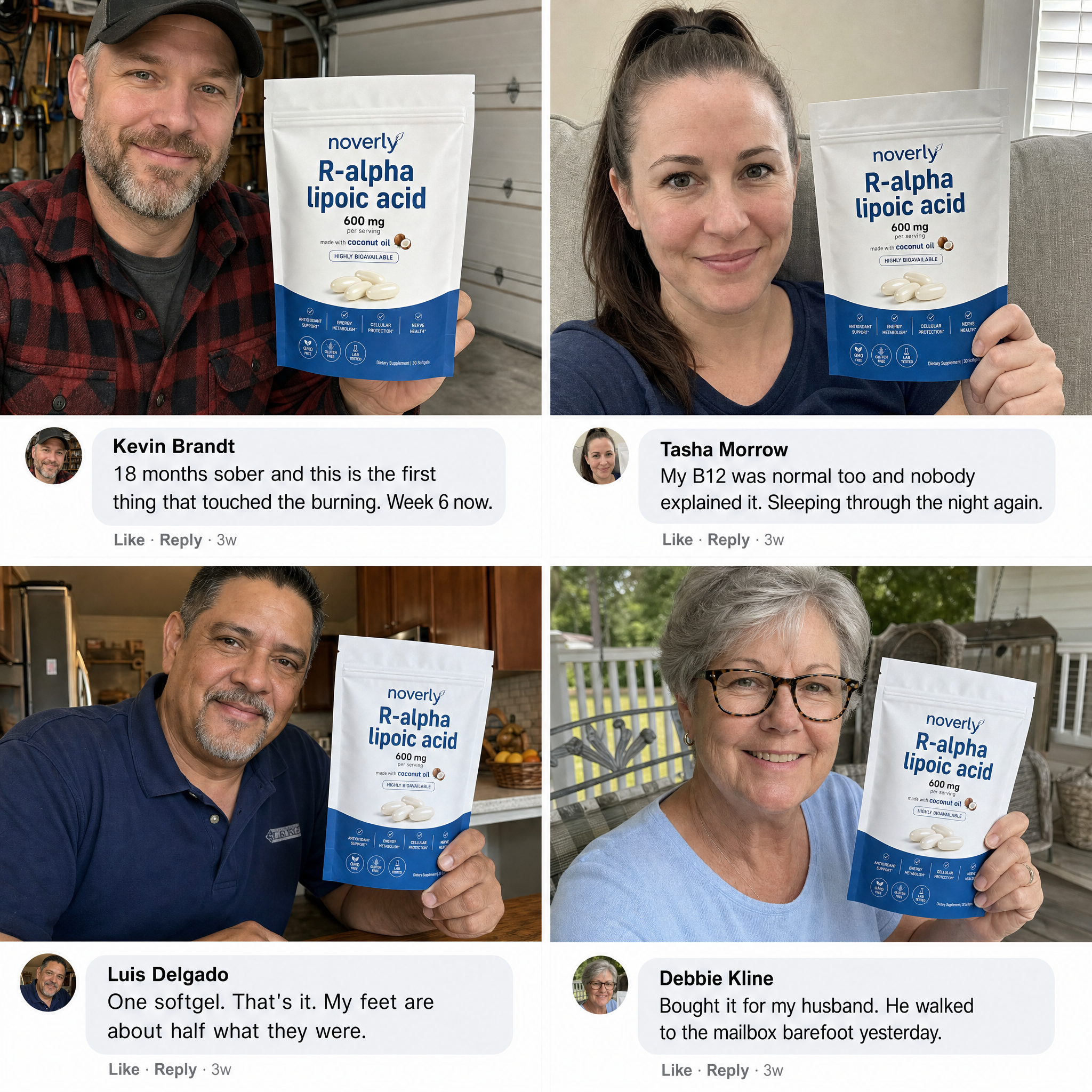
"The hospital told me my B levels were normal and nobody ever explained what that meant. Seven weeks on this and I can stand in the shower again without bracing for it."
"Women get this too and nobody says it. The night burning is about half what it was by week eight. The numb spot on my left heel hasn't changed, so read that part. I'm staying on it."

"One softgel instead of the handful I was taking. Nothing for the first three weeks, which he warns you about. Around week five my feet stopped waking me up."

"Nothing on the pouch says why I take it, which mattered to me more than I expected. Two months in, I walked the dog around the whole block and my feet were just feet."
You Have Two Choices Right Now
Keep paying the bill
Another year of the B-complex and a creeping dose, treating the burning as the price of your past. The shield stays stripped, and the longest nerves keep taking the damage.
Test the shield for 90 days
One softgel a day alongside everything you already take. Score your nights out of ten now, score them again at week eight, and let the number decide. If it does nothing, you pay nothing.
I’m Not Selling You Hype. I’m Showing You What Worked.
Ninety days. If your nights are not measurably quieter, you send one email and get every penny back. You keep the pouch.
- The active R-form only — no synthetic mirror-image half taking up the dose
- 600 mg per serving — the dose used in the human research on nerve damage
- One coconut-oil softgel a day — not six horse pills, and no B6 stacked on top
- Honest about the limits — the night burning moves first, numbness is the slowest thing to change, if it changes, and nobody should expect anything in week one
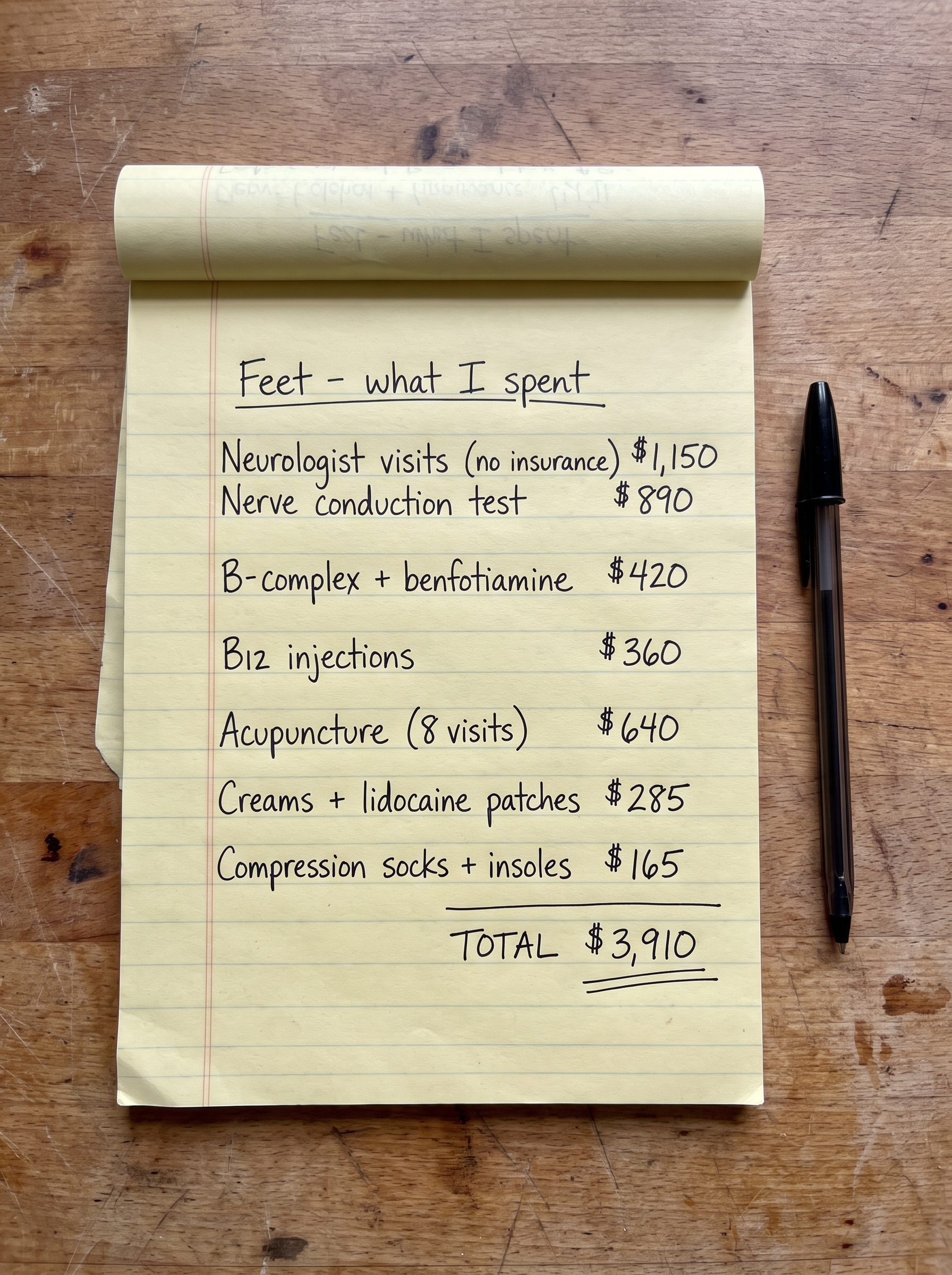
I spent years and just under four thousand dollars finding this out the expensive way, most of it while I had no insurance. I kept the paperwork.
Here’s Exactly What Happens When You Order
You pick your supply, check out, and a confirmation lands in your inbox within a minute. The price you see is the price you pay.
It ships with tracking in a plain pouch. Nothing on the pouch mentions drinking.
One softgel with a meal. Keep taking everything your doctor has you on — this goes alongside it, not instead of it.
This is where most people tell me the nights change. Score it out of ten from day one so you have something honest to compare against.
No change? One email, full refund, and you keep the pouch. I would rather refund you than have you write it off the way I nearly wrote it off.
One more thing: every order comes with the First Week Guide — short answers to the questions everybody sends me, including taking it alongside a prescription, why the first weeks often feel like nothing, and what to do if you slip. No lecture. Just what to do next.
That is it. No extra pills. Just the R-form at the dose that was actually studied.
This Isn’t Amazon. We Make Small Batches.
Two Questions To Ask Yourself
If the answer to both is no, here’s the whole thing in one line:
If it doesn’t work, you get your money back. If it does, you get your nights back.
That thread is still going. It finds somebody new every week — usually at two in the morning, usually a few months sober, usually typing the same three words I typed.
P.S. — People ask why we don’t mass-produce it and put it in every pharmacy. Because the expensive part is the part everyone else cuts. The moment you scale this you start buying racemic, and the moment you buy racemic you are selling the fifteen-dollar tub that wasted three months of my life.
You’ve Been Burned Before. Here’s Why This Is Different.
Ninety days. Full refund, any time inside that window, for any reason. You keep the pouch whether it is full or empty. You don’t ship anything back, and nobody quietly signs you up for a monthly plan you didn’t ask for.
I know exactly what it feels like to spend money on hope and get nothing, because I did it eleven times in a row — some of it with money I didn’t really have.
Of the 27,318 people in this, two have asked for a refund. Either it does something for you or it costs you nothing — those are the only two outcomes on offer.
So wherever you are right now — three weeks sober or three years, feet on top of the covers, told this is just what you get now — you can be the next person that thread finds.
Every batch third-party tested. Plain pouch. Keep it even if you ask for a refund.
The night I first tried it I almost didn’t bother. I had a drawer full of bottles that had all promised me something, and I honestly believed I was buying the twelfth disappointment.
Eight weeks later I was sleeping with my feet under the covers and walking the loop around the park with my wife.
For years I believed the burning was what I deserved. It wasn’t. It was glutathione, and nobody had told me. That is the part I can’t let go of — not for me, but for everybody in that thread still paying a bill they don’t owe.
If you are where I was — sober, proud of it, and still on fire every night — give yours the same ninety days I gave mine. Score it out of ten. Let the number tell you.
— Dennis Kowalczyk, 7-Year Nerve Recovery Researcher, Toledo, OH
© 2026 Noverly · Terms · Privacy · Contact